
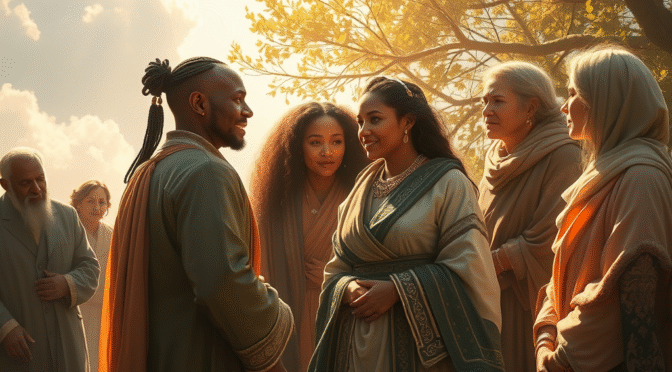
What’s struck me most in these stories is this: the greatest among these leaders didn’t cling tightly to power. Instead, they understood that real strength is found in using influence for the good of others—and in trusting that the work done in faith and love will outlast them. In 1797, when John Adams was sworn in as the second President of the United States, the world witnessed something unprecedented: a peaceful transfer of power. No war, no bloodshed—just the commitment to a shared vision for the common good. That moment was more than political; it was moral, even spiritual.
Today, we often find ourselves entrenched in arguments over details, acting as if we’re on opposing teams. We forget we are one team—one people—called to seek the greater good of our communities and our nation. What’s disheartening is how this combative spirit has crept into our churches. Too many of us speak with absolute certainty, as if God Himself etched our opinions into stone and handed them down on a mountaintop behind our church. But God’s truth is far more complex, revealed not through a single voice, but through the lives of countless people across history, culture, and circumstance.
I’ll be honest: I’ve fallen into the trap of certainty too. I’ve clung to my own answers, forgetting that Joey down the street, or Connie Sue across the pew, don’t have the full picture either. But together—together—we begin to fill in the numbers of the divine paint-by-number that God has placed before us. And when we listen to each other’s stories, when we honor each other’s perspectives, we start to see the shape of God’s direction: love.
It always comes back to love, doesn’t it? We lost paradise, but God gave us the tools to survive. We found ourselves in chains—some placed by others, some of our own making—but God broke them. Over and over, we took wrong turns, spoke wrong words, committed wrong deeds, and still, God sent Jesus—an act of ultimate love—to set us free. And yet, somehow, in today’s world, if someone disagrees with us, votes differently, or belongs to another community, we’re ready to cast them out. Yeah, I said it.
Love doesn’t mean agreeing with everything. And it definitely doesn’t mean condemning everything we disagree with—unless an action brings real harm to another person, regardless of their stage of life or identity. Love, as it was once described to me, is wanting God’s very best for every person. And that best, I believe, is found in a life anchored in Jesus Christ.
That’s the direction God points us toward when Jesus says the two greatest commandments are to love God and love our neighbors. Not because God needs our love—but because when we seek Him, we align ourselves with His heart. And when we love our neighbors, we should want for them what we want for ourselves: a deep, sustaining relationship with the living God.
When that becomes our focus—loving God and loving people—we begin to catch a glimpse of heaven on earth. We begin to live into a vision where voices are heard, where differences make us stronger, where unity is more than a slogan. Yes, it may seem idealistic—but it’s the very prayer Jesus taught us to pray: “Your will be done on earth as it is in heaven.” It’s the call of Micah 6:8: “He has shown you, O mortal, what is good. And what does the Lord require of you? To act justly, and to love mercy, and to walk humbly with your God.”
It’s a vision of lions and lambs, of strength and gentleness woven together. A vision captured in the words engraved on General Dwight Eisenhower’s desk: “Gentle in manner, great in deed.”
So let’s begin speaking words that draw us closer, not push us apart. Let our manner be gentle like the lamb, but may our love—our courageous, Jesus-shaped love—be mighty like the lion.