It seems like every few years, a new movement rises up to shout, “No kings!” It’s an old sentiment wearing a fresh coat of paint — this time around, protesters marched with banners declaring their independence from any authority that dares to tell them how to live, think, or believe.
I watched some of the coverage this past Saturday, and I couldn’t help but feel a strange mix of understanding and sadness. On one hand, who among us hasn’t felt the pull to push back against control? We love our freedom — it’s part of our national DNA. But on the other hand, this “No Kings” cry reveals something deeper, something that runs to the very heart of the human condition: we want to be our own rulers.
And that’s not new at all. It’s as old as Eden.
The First “No Kings” Protest
When Adam and Eve bit into that forbidden fruit, it wasn’t about hunger — it was about autonomy. They didn’t want to live under God’s rule anymore. They wanted to call their own shots. “No kings,” they said, though not with words but with a bite.
The book of Judges ends with a haunting line:
“In those days Israel had no king; all the people did whatever seemed right in their own eyes.” — Judges 21:25 (NLT)
That verse could easily headline our news today. We’ve traded monarchs for algorithms, prophets for influencers, and the idea of divine order for personal preference. Everyone is their own authority, their own truth, their own moral compass.
Yet that kind of freedom isn’t freedom at all — it’s a slow unraveling. When everyone is their own king, we end up in conflict. When everyone defines truth, truth itself loses its meaning.
A Fisherman’s Reflection
As a fisherman I am always tryting to outsmart some particularly uncooperative fish. As I cast and reeled in my line, I’ve noticed how often I get impatient. I want the fish to bite now, the weather to stay perfect, and the line to land exactly where I planned. In other words, I wanted to be in control.
And as any fisherman knows, that’s not how it works. You can’t force nature into submission. You can prepare, you can learn, you can cast — but at the end of the day, you’re at the mercy of something beyond you.
I think that’s why Jesus chose fishermen. We understand dependency. We know what it’s like to wait, to trust, to not be in control. That’s also what it means to follow one King — to lay down the illusion that we can captain our own ship.
The Only King Worth Following
Jesus didn’t come to establish an earthly kingdom with borders and palaces. He came to reclaim hearts that had wandered off in search of their own thrones.
“My Kingdom is not of this world,” Jesus said. — John 18:36 (NLT)
His crown was made of thorns, not gold. His throne was a cross. His power came through humility, and His rule through love. In a world shouting, “No kings!” Jesus quietly whispers, “Follow Me.”
And that’s where it gets uncomfortable. Because following Jesus means giving up the right to rule ourselves. It means surrendering our favorite excuses, our private ambitions, our moral shortcuts, and our insistence that we know best.
It’s not an easy message — but it’s a freeing one.
The Ant and the Steering Wheel
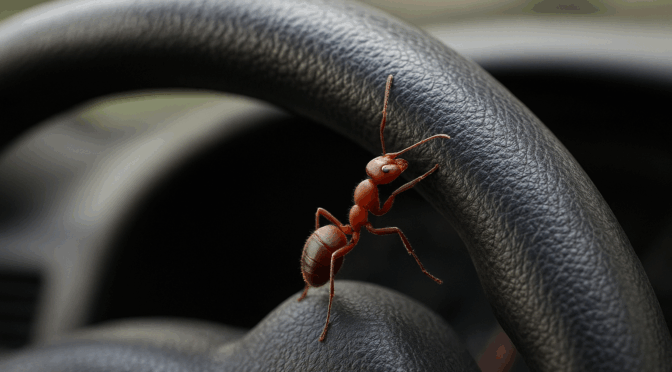
I once heard a story about an ant who decided to drive a car. The ant climbed up to the steering wheel, gripped it tight, and started shouting orders: “Go left! Go right!” The car, of course, didn’t move an inch.
After a while, the ant began to pray. “Lord, give me strength!”
Suddenly, the engine roared to life, the car began to move, and the ant proudly yelled, “Look at me go!”
It’s funny — and painfully familiar. We humans love to believe we’re steering. But maybe we’re more like that little ant: tiny, limited, and invited to trust the One who’s actually in control.
Freedom Under the King
Real freedom isn’t found in rejecting authority — it’s found in submitting to the right one.
When we follow Jesus, we aren’t losing ourselves; we’re finally discovering who we were created to be. The Apostle Paul put it this way:
“For the Lord is the Spirit, and wherever the Spirit of the Lord is, there is freedom.” — 2 Corinthians 3:17 (NLT)
Freedom in Christ isn’t anarchy; it’s alignment. It’s not the absence of rules; it’s the presence of grace. It’s not about “no kings” — it’s about one King who knows us, loves us, and leads us toward life.
No Kings… or One Worth Serving?
We can look at the “No Kings” protests and shake our heads, but if we’re honest, there’s a “no kings” protest inside each of us. Every time we say, “I’ll do it my way,” or “I don’t need help,” or “God, I’ve got this,” we’re marching in our own little rebellion.
And yet, even in our defiance, Christ calls us back. He doesn’t demand submission through force — He invites surrender through love.
Maybe that’s the real difference between the world’s kings and Christ. The world’s kings demand power; Jesus lays His down. The world’s kings rule through fear; Jesus rules through forgiveness. The world’s kings come to be served; Jesus came to serve.
A Closing Thought
When we live with “no kings,” life becomes a contest of wills — mine versus yours, truth versus opinion, noise versus noise. But when we live with one King, we find peace in the midst of chaos, purpose in the midst of confusion, and grace in the midst of our imperfections.
So maybe the real question isn’t whether there should be kings at all — but whether the One who already reigns has been given rule over your heart.
“For this reason, God elevated Him to the place of highest honor and gave Him the name above all other names, that at the name of Jesus every knee should bow.” — Philippians 2:9–10 (NLT)
So I wonder, where in your life have you been gripping the steering wheel like that little ant — and what might happen if you finally let the true King drive?
________________________________________