
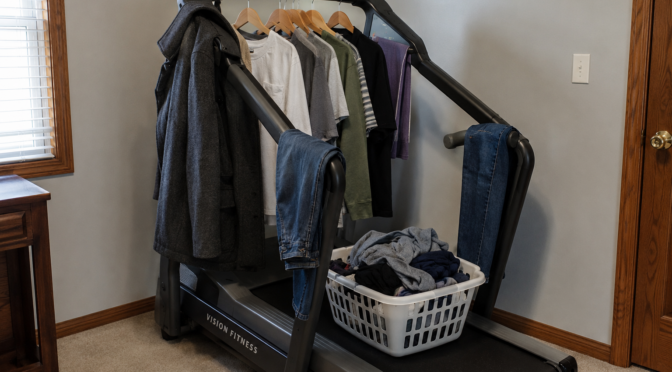
Go ahead. I’ll wait.
What did you find? Are there a couple of heavy sweatshirts from last winter draped over the handles? Maybe a pair of jeans that don’t quite fit right now hanging from the side rails? A stray towel? A basket of laundry that you’ve been meaning to fold since Tuesday?
The reason I ask is because I was scrolling through Facebook Marketplace the other day, just killing time, when a listing caught my eye. It made me laugh out loud, but then it made me sit in silence for a really long time.
It was an ad for a treadmill. The description started off like this:
“Just finished a bedroom remodel and have more space in our closet, so we are now selling our gently used treadmill.”
That part wasn’t the funny part. The funny part was the photo. Attached to the listing was a picture of this treadmill, completely buried under a mountain of clothes. There were shirts hung neatly by their hangers on the side rails, sweaters piled high on the running belt, and a jacket thrown over the digital console. It had literally been repurposed as a massive, expensive, metal coat rack. The owners didn’t need the treadmill anymore because they finally built a bigger closet to hold the clothes that had taken it over.
Once I stopped chuckling, my mind started wandering. I started thinking about all the things in our lives that we buy or invite into our spaces with the absolute best of intentions, but we don’t actually use them for what they were made for.
Human beings are kind of famous for this, you know. We take something designed for one specific, incredible purpose, and we twist it into something completely different.
Did you know that when Listerine was first introduced back in 1879, it wasn’t meant for your breath at all? It was originally invented to clean surgical wounds and help doctors scrub down flesh before surgery. Later on, they marketed it as an all-purpose cleaner. For years, people were using it to scrub their kitchen floors and treat athlete’s foot before anyone ever thought to gargle with it.
Or think about bubble wrap. The geniuses who invented it in 1957 were actually trying to create a trendy, textured, plastic wallpaper. Can you imagine lining your living room walls with bubble wrap? It failed miserably as home decor, but today, we use it to protect fragile things in transit—and, let’s be honest, to drive our family members crazy by popping the bubbles the second a package arrives.
We do this all the time with common household items. We use butter knives as screwdrivers. We use old coffee mugs to hold rusty nails in the garage. We use heavy textbooks as doorstops.
But as I sat there looking at that picture of the treadmill buried under a pile of laundry, a much deeper, much heavier question hit me right in the chest. It’s a question I want to ask you, and I want to ask myself:
In what way are we using our relationship with Jesus?
Have we done the exact same thing to Him? Have we taken the living, breathing, dynamic invitation of Christ and turned it into an expensive, underutilized piece of furniture in our lives? Have we piled so much stuff on top of Him that we can’t even see what He was originally intended for?
I’ll be the first to admit something to you: I have struggled with my weight and my physical conditioning for a lot of my life. It is a real, daily, vulnerable mountain to climb. And over the years, whenever I hit a point where I felt frustrated or out of shape, buying a piece of exercise equipment always seemed like the right answer. It felt like a monument to hope.
In my mind, the moment that machine entered my house, I was going to become a runner. I was going to be healthy. I was going to feel vibrant and strong.
But here is the hard truth about a treadmill: it doesn’t possess magic powers. Just owning it doesn’t lower your cholesterol. Stepping over it on your way to the kitchen doesn’t strengthen your heart. Unless you actually turn it on, step onto the belt, and use it properly for its intended purpose, it does absolutely nothing for you. It doesn’t strengthen you, and you will never see the benefits of what it was engineered to do.
Instead, because we aren’t using it, we start to feel a little guilty every time we look at it. It becomes a reminder of what we aren’t doing. So, to make ourselves feel better, we start treating it like a piece of furniture. We throw a jacket over it. Then a pair of pants. Then a blanket. Before you know it, the machine is completely hidden. It’s still there, right in the middle of the room, but its original purpose has been entirely suffocated by the clutter of daily life.
I think a lot of us have done the exact same thing with faith.
Maybe you are someone who didn’t grow up in church at all. Or maybe you are someone who used to go, but you walked away because you got completely burnt out by the rules, the politics, the judgment, and the exhausting performance of it all. You might be totally “done” with organized religion, but you still have this quiet, persistent ache inside of you that wonders if there was actually something real underneath all the noise.
You see, many of us sought out Jesus with beautiful, genuine intent. We were lonely, or we were broken, or we were looking for a life that felt like it actually mattered. We looked at Jesus and thought, “Yes. That is what I want. I want that love. I want that peace.”
But somewhere along the way, we wrongly applied what we found. Instead of letting Jesus change the way we live and love, we allowed religion to pile a bunch of heavy, dusty clothes on top of Him. We turned a life-giving relationship into a rigid, dusty monument.
Why Did He Show Up in the First Place?
To understand how we get the relationship so wrong, we have to pull back all the layers of laundry and look at what Jesus actually said He came to do. What was His original purpose? Why did He step into our messy, chaotic world in the first place?
If you ask a lot of modern churches, they might tell you He came to start a country club with a really strict dress code and a long list of people who aren’t allowed inside. But if you look at the actual biographical accounts of His life, Jesus paints a completely different picture.
There are two major moments in the scriptures where Jesus clearly defines His own mission statement. He didn’t leave it up for guess work. He spelled it out for us, and both times, He did it in the middle of everyday life, speaking to people who felt entirely left out.
1. To Seek and to Save the Lost (Luke 19:10)
2.
The first place we see this is in the book of Luke, chapter 19. Jesus is walking through a crowded city called Jericho. There’s a guy there named Zacchaeus who is a chief tax collector. In those days, tax collectors weren’t just disliked; they were viewed as traitors and thieves. They worked for the oppressive Roman government and skimmed extra money off their own neighbors to line their own pockets. Nobody liked Zacchaeus. He was the definition of an outsider. He was spiritually and socially isolated.
Because Zacchaeus was short, he climbed up into a sycamore tree just to get a glimpse of Jesus passing by. Now, if Jesus were like a lot of religious folks today, He probably would have pointed at the man in the tree and used him as an object lesson on how not to live. He would have told him to clean up his act, pay back the money, and come back when he was respectable.
Instead, Jesus stops right under the tree, looks up, calls Zacchaeus by his name, and says, “Hey, come on down. I’m having dinner at your house today.”
The religious crowd went wild with anger. They started muttering, “He went to be the guest of a sinner!” They couldn’t believe Jesus would contaminate His reputation by hanging out with someone so compromised. But during that dinner, without a single heavy sermon or angry lecture from Jesus, Zacchaeus’s heart completely melts. He stands up and promises to give half his wealth to the poor and pay back anyone he cheated four times over.
Seeing this radical transformation, Jesus looks around the room and delivers His core mission statement:
“For the Son of Man came to seek and to save the lost.” (Luke 19:10)
Notice the order of the words there. Jesus didn’t say He came to wait around for the lost to find Him. He didn’t say He came to judge the lost for being lost. He said He came to seek them. It is an active, pursuing, loving search.
Think about it this way: if you lose your car keys in the house, you don’t stand in the middle of the kitchen and scream at the keys for being irresponsible. You don’t tell the keys that they need to become better keys before you’ll look for them. No, you go on a relentless hunt through the couch cushions and under the counters because those keys are valuable to you, and things can’t function right without them.
That is the heart of God’s grace. It is a grace that is wild, free, and available to absolutely everyone. It’s what theologians call “prevenient grace”—the love of God that goes before us, chasing us down long before we ever even think about turning toward Him. Jesus didn’t come to set up a hurdle setup where only the best jumpers get to win. He came to find the people who were stuck in the bushes and carry them home.
3. A Life of Abundance (John 10:10)
4.
The second time Jesus explicitly defines His purpose is in the book of John. He is talking to people about what it means to be cared for, using the imagery of a shepherd and his sheep. He contrasts Himself with the religious leaders of His day, who were using people, taking their money, and making their lives incredibly heavy with legalistic burdens.
Jesus looks at the tired, worn-out crowd and says:
“The thief comes only to steal and kill and destroy; I have come that they may have life, and have it to the full.” (John 10:10)
Some translations say, “that they might have life abundantly.”
Let’s be really clear about what Jesus means here, because this verse gets misused all the time. An abundant life doesn’t mean a life where you suddenly get a promotion, a mansion, and a perfect bank account. Jesus wasn’t a life coach trying to help you maximize your material success.
The word “abundance” here means a life that is overflowing with meaning, connection, peace, and love. It’s a life where your soul is healthy, no matter how chaotic the world around you gets. It’s the kind of life where you don’t have to pretend to have it all together, because you know you are completely loved just as you are.
When you tie Luke 19:10 and John 10:10 together, you get the beautiful, original intent of Jesus: He came to find people who felt disconnected and lost, and invite them into a rich, beautiful, free relationship that brings true life to their souls.
He didn’t come to build a museum of perfect people. He came to launch a movement of rescued people who know how to love.
So, if that was His original purpose, how on earth did we get to where we are today? How did we end up with a religious culture that often feels so cold, so exclusive, and so incredibly heavy?
We did it by taking our eyes off the purpose of the machine and using it to hoard clothes.
When we wrongly apply our relationship with Jesus, one of the first things we do is become self-righteous. We start believing that because we have invited Jesus into our lives—or because we sit in a specific building on Sunday—we are somehow fundamentally better, cleaner, or more righteous than the people who don’t.
We start holding ourselves higher than those who don’t see things the way we do. We look out the window at the world, and instead of seeing people who are deeply loved and sought after by a pursuing God, we see people to judge, criticize, and fix.
We turn our faith into a moral club. We use it to score points. We weaponize the very relationship that was meant to make us humble, and we use it to push other people down.
Think about how this plays out in our ordinary, messy days. It doesn’t usually start with a giant theological argument. It starts in the small, ugly moments.
It happens when we get cut off in heavy traffic on the highway. What’s our immediate internal reaction? Is it grace? Is it a prayer for the person who might be having a terrible day or rushing to a medical emergency? Or is it a flash of hot anger and a feeling that our time is more valuable than theirs?
It happens when we click on social media and see someone post a political understanding or an opinion that completely contradicts our own. What do we do? Do we lean in with empathy, trying to understand the human being behind the screen? Or do we immediately launch into a mental tirade, labeling them as stupid, wrong, or evil?
In those moments, the manner in which we love does not strengthen our relationship with Jesus at all. In fact, it does the exact opposite. Every time we choose pride over humility, every time we choose judgment over empathy, and every time we choose to stay comfortable in our self-righteousness, we are throwing another heavy winter sweatshirt onto the treadmill.
We are creating massive, suffocating barriers that prevent us from experiencing His true intent. We become so busy managing the clutter of our opinions, our traditions, and our moral superiority that we don’t actually move. We aren’t growing stronger. Our hearts aren’t becoming healthier. We are just standing in a room, surrounded by a bunch of religious clutter, wondering why our spiritual lives feel so incredibly stagnant.
If you are someone who feels done with the way church has been done—if you are tired of the weaponized faith, the political posturing, and the heavy piles of judgment—I want you to hear this loud and clear: Jesus is tired of it too.
He never asked us to build a coat rack out of His grace. He asked us to walk with Him.
So, how do we begin to move into a real, authentic relationship with Jesus moving forward? How do we clear off the exercise equipment and finally start using it for what it was made for?
It starts with three incredibly simple, profoundly hopeful steps.
Step 1: Clear off the Laundry
You cannot start running on a treadmill until you take the clothes off the belt. In the same way, you cannot experience the true life of Jesus until you decide to drop the religious performance and the self-righteous clutter.
We have to stop pretending we are better than anyone else. We have to admit that we get cut off in traffic and get angry. We have to admit that we don’t have all the answers. We have to look at the people around us—especially the ones we disagree with the most—and remember that Jesus is actively seeking them with the exact same fierce, unstoppable love that He uses to seek us.
When you clear off the laundry of having to look perfect, a massive weight lifts off your shoulders. You realize that faith isn’t about being right; it’s about being loved, and learning how to love in return.
Step 2: Step onto the Belt
A treadmill only works if you actually get on it and turn it on. A relationship with Jesus only works if you actually start practicing His way of life in the real, ordinary moments of your day.
Faith isn’t a set of ideas you agree with in your head. It’s a way you walk with your feet.
Moving into a relationship with Jesus means that the next time you get cut off in traffic, you breathe out grace instead of anger. It means that the next time you encounter someone with a completely different political understanding, you choose to treat them with honor and kindness, rather than dismissal. It means you stop trying to use Jesus as a shield to keep people away, and you start letting Jesus soften your heart so you can pull people close.
It’s about making the daily choice to believe that His way of love, humility, and sacrifice is actually the best way to live.
Step 3: Enjoy the Strength of the Abundant Life
When you start using exercise equipment consistently, something beautiful happens over time. At first, it’s hard. Your muscles ache, and you gasp for air. But if you keep at it, your lungs expand. Your heart gets stronger. You find yourself with more energy, more endurance, and a greater capacity to handle the stresses of life.
The exact same thing happens when you step into a genuine, uncluttered relationship with Jesus.
As you practice His love, you find that your capacity for joy expands. Your anxiety begins to lose its grip. You start to experience that “abundant life” He promised—not because your circumstances are perfect, but because your soul is anchored in a grace that cannot be shaken. You stop looking at faith as a heavy obligation, and you start seeing it as the incredible, life-giving source of strength it was always meant to be.
Let’s go back to that Facebook Marketplace ad for just a moment.
The people selling that treadmill were letting it go because they built a bigger closet. They decided it was easier to just make more room for their clothes than to actually use the machine for running. They gave up on the dream of conditioning, packed up the machine, and sold it to someone else.
I don’t know where you find yourself today. Maybe your faith feels like it’s buried under years of church hurt, hypocritical behavior, or personal disappointment. Maybe you’ve been tempted to just put your faith on the marketplace, post a picture of the clutter, and walk away from it entirely.
But before you click “sell,” I want to invite you to do something different.
Don’t give up on Jesus just because the version of religion you experienced turned Him into a coat rack. Toss the sweatshirts off the handles. Clear the laundry off the belt. Look at Him again, completely bare, beautiful, and full of grace.
Listen to His voice calling your name, just like He called Zacchaeus out of that tree. Hear Him reminding you that He didn’t come to condemn you or burden you. He came to find you, to rescue you, and to give you a life that is full to the absolute brim.
The machine isn’t broken. It’s just waiting for you to take the first step.
What do you think?
• Have you ever bought a piece of household equipment that ended up serving a totally different, funny purpose?
• More importantly, have you ever felt like your view of Jesus got completely buried under the “laundry” of religious rules or judgment?
Let’s talk about it in the comments below—I want to hear your stories.