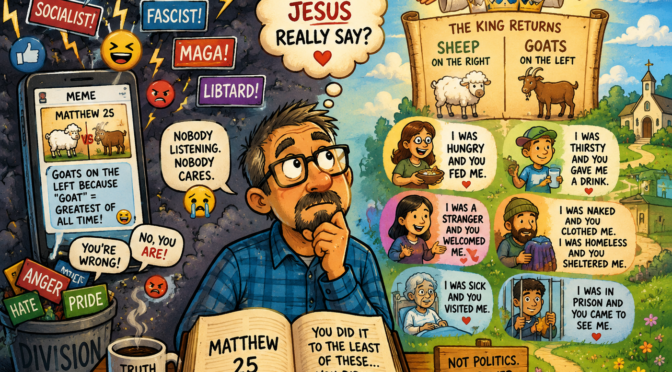
A New Way of Seeing – Why we argue over goats and sheep
Speaking the truth can be a tricky thing. When we are kids, telling the truth is usually the quickest way to get out of trouble or ease a correction from our parents. But when we grow up, things change. If we speak honestly as adults, without adding a personal slant to the story, we quickly experience the consequences of that truth. Sometimes, that truth makes people very uncomfortable. In fact, it might even offend a few folks. I do not mean to hurt anyone’s feelings, but I have noticed that when you look at what the Bible actually says instead of what we want it to say, everybody gets a little bit irritated. Let me give you an example of what I mean.
In the Gospel of Matthew, chapter 25, Jesus tells a famous story about His return. He says that when the King comes back, He will separate people into two groups. He will put the sheep on His right side and move the goats to His left side. I suspect some of you already see where this is going, but let me tell you about a funny thing that happened on my own social media page recently.
A friend of mine posted a meme about this exact Bible verse. The responses in the comment section were all over the place. A few people gave it a thumbs-up emoji. Several people posted laughing faces. A few others left angry, red faces.
If you scrolled down into the actual text of the comments, things got ugly fast. Some of the language should have been rated PG-13. Honestly, it made me question if these folks ate their dinner with the very same fingers they used to type those nasty comments, if you know what I mean.
But then I had to laugh. A whole group of people suddenly got up on their soapboxes to argue about the grammar. They claimed that of course the goats were on the left because the word “GOAT” is a modern acronym for the “Greatest Of All Time.” They thought Jesus was throwing shade at the best people!
Oh boy, did that fire up the conversation. Within minutes, the whole post turned into a political shouting match. People started tossing around heavy labels like socialist, fascist, MAGA, and libertard. Nobody was listening to anybody else. There was absolutely no conception of real social discourse. It had turned into a total free-for-all. The only emoji I could muster in my own mind was the one where the yellow face has its eyes slightly closed, looking down, with a single tear running down its cheek.
It made me sad to see how quickly a lesson from Jesus could be turned into a weapon for our modern political shouting matches.
What Did Jesus Actually Say?
After watching that online circus, I decided to pull out my Bible. I wanted to read the rest of this teaching by Jesus to try and understand the real lesson He was trying to get across.
If you go back and look at the context, Jesus is talking about His future return. This conversation happens right before His arrest, before the crucifixion and burial, and even before the resurrection and ascension. Jesus was preparing His followers for a long deployment. He was telling them that what they were about to experience with His death was not the end of the story. There was real hope. He promised that He would one day return in glory.
However, Jesus made it clear that when the King returns, He is going to take a very close look at the manner in which we lived our lives. In verse 34, Jesus looks at the people on His right side—the sheep—and tells them they will inherit the Kingdom of God. Why do they get this reward? He tells them that when they encountered someone who was hungry, they fed them. When they met someone who was thirsty, they gave them a drink. When a stranger showed up, they welcomed them in. When someone was naked or homeless, they provided clothing and shelter. And even when people were sick or locked up in prison, these individuals took the time out of their busy days to go and visit them.
The followers in the story are completely confused by this. They look at the King and ask, “Lord, when did we ever see you hungry, or thirsty, or lonely, or sick, or in prison? When did we do these things for you?” And Jesus gives the famous response: “When you did this for the least of these, my brothers and sisters, you did it to Me.”
The Great Political Tug-of-War
This entire passage is one of the most argued pieces of scripture in the whole Bible. The problem is that almost everybody argues it completely wrong because they want to use Jesus to prove that their specific political side is correct.
Let’s look at the first group of people. There is a large crowd today who will argue that Jesus is speaking directly to political nations. They look at the state of the world and say that our country, as a whole governmental system, should be the one working to provide free food, housing, and healthcare. They believe our prison systems should be run differently by state laws and that the government should use tax dollars to make sure every single citizen has clean drinking water, clothes, and a place to live.
They look at the wealthy and think about fairness. They look at the people who have millions or billions of dollars and say, “It isn’t fair that some folks have so much money while others have nothing. The government needs to step in, take a portion of that wealth through taxes, and distribute it to the people who need it.”
I find this argument deeply curious, especially looking at it from my context as a citizen of the United States. It is often the exact same group of people who will argue passionately that our country must keep the church and the government completely separated. They do not want religion in public schools, and they do not want laws based on the Bible. Yet, at the exact same time, they turn around and demand that the state budget reflect the personal heart of Jesus.
I am not sure that it is possible to have it both ways. You cannot demand the fruit of the spirit from a machine that you stripped the spirit out of.
It reminds me of that old Willie Dixon blues song that was first released by Bo Diddley called “You Can’t Judge a Book by Its Cover.” In the lyrics, he sings that you can’t judge the honey by looking at the bee. That sounds nice, but I would contend with that lyric: how in the world would you ever have honey without the bee in the first place?
In other words, how could the personal, loving heart of Jesus be present in a government system if Jesus Himself isn’t welcome there? A government bureau is a cold, mechanical thing. It runs on forms, red tape, and automated systems. It does not have a soul. But still, many folks want us to respond to poverty by using our national systems to force a reflection of Christian morals and values.
They want the honey, but they want to ban the bee.
The Danger of Institutional Giving
On the flip side, you have people who realize the government cannot be the savior. They look at the problem and say, “No, this isn’t a job for Uncle Sam. This is a job for the church.”
They believe Jesus was speaking directly to religious institutions, telling the church leaders and congregations that they are the ones who hold the collective responsibility to fix society. So, churches have taken up this mantle. They do a lot of good things. They build mission-based groups, stock up food pantries, run thrift stores, and open low-cost or no-cost shelters.
These ministries are often run by small groups of faithful folk who go out into the community to seek the least, the last, and the lost. But if we are being completely honest, this model has a major flaw too. Institutional church work is often limited by two big things: finite resources and human judgment.
Because churches are institutions run by humans, they tend to start judging the needs of others through the lens of their own choices. They look at the person standing in the food pantry line and start asking questions behind the scenes. “Why don’t they have a job? What are they spending their money on? Do they deserve this help, or are they just taking advantage of us?”
Suddenly, the open-hearted love of Jesus gets trapped behind a checklist of rules and parameters. The help becomes conditional. We end up with small pockets of humanity helping small pockets of their brothers and sisters, but only if those brothers and sisters fit into the right boxes or believe the right things. It becomes a system of corporate charity rather than personal relationship.
Sometimes, the desire to handle things through a local church program is less about loving the neighbor and more about controlling the situation. It lets the individual church member write a check or drop off canned goods so they can feel like they checked the box, without ever having to sit down, look a broken person in the eye, and learn their name.
The Shocking Greek Grammar Lesson
But what if I were to offer you a completely different option? What if Jesus was not talking to the federal, state, or local governments at all? And what if He wasn’t even talking to the church as an organized institution?
What if I were to offer to you that Jesus was looking past the presidents, past the governors, past the preachers, and past the committees, and was looking directly at you?
Let’s talk about that for a minute.
A lot of people read this story in the Bible and get confused because verse 32 says, “All the nations will be gathered before him.” They see that word “nations” and immediately think of big systems, national borders, and political parties. They think Jesus is putting America, Canada, or Rome on trial. But if you look closer at the text, Jesus isn’t talking to a system. He is talking to the individual.
To really understand the depth of what Jesus is saying, we have to put on our detective hats and look at the original Greek language that the New Testament was written in. There are two specific words in this passage that completely change how we see the whole story.
First, let’s look at that word “nations.” In the original Greek text, the word used is ethne. This is where we get our modern English word “ethnic.” It means a collection of people, a crowd, or a specific people group. In the ancient Greek language, this noun is considered grammatically neutral. It does not have a masculine or feminine gender.
Now look at the very next sentence in verse 32. Jesus says the King will separate “them” one from another, just like a shepherd separates the sheep from the goats.
Here is the kicker: in the original Greek grammar, the word Jesus uses for “them” is autous, which is a masculine pronoun.
Why does a dry, boring grammar rule matter so much for our lives today? Because a neutral noun like ethne (nations) cannot be paired with a masculine pronoun like autous (them) if you are talking about the nations themselves. By shifting the grammar from neutral to masculine, the text shows us that Jesus is not separating the political structures or the geographical nations. He is reaching inside those nations and separating the individual people out from the crowd!
Think of it like a giant school project. Imagine your teacher stands up in front of the classroom and says, “The whole class is going to be graded on this project.” But then, instead of giving a single grade to the room, the teacher walks down the aisles, looks at every single desk, and hands out individual grades based on exactly what each student did.
Jesus does not look at a government’s tax ledger or a nation’s welfare policy. He doesn’t look at a church’s annual budget report. He looks at a single, living human being. He looks at you, and He looks at me.
The King looks us in the eye and says, “I was hungry, and you gave me food. I was lonely, and you visited me.” A government agency cannot look someone in the eyes and show them the love of God. A government program cannot sit by a hospital bed, wipe away a tear, or hold a dying person’s hand. A state department cannot walk into a prison cell and offer genuine human friendship. Only a real, individual person can do those things.
Jesus is telling us that changing the world is not someone else’s job. It is a personal, daily choice that lands squarely on our own doorsteps.
The Beautiful Puzzle of Society
When we realize that Jesus is talking to us as individuals, it flips our entire world upside down. It strips away our ability to make excuses.
Think about how easy it is to point fingers when we see a problem. When we drive past a homeless person on the corner, one side might say, “The government needs to build a shelter for that man.” The other side might say, “The local church needs to start a ministry for people like him.” Both sides are doing the exact same thing: they are passing the buck. They are using an institution as a shield to protect themselves from the raw, uncomfortable reality of human suffering.
But Jesus pulls that shield away. He says that each of us is an individual puzzle piece.
Think about how a jigsaw puzzle works. A puzzle is made up of hundreds of tiny, uniquely shaped pieces of cardboard. No single piece can show you the whole picture on its own. If you just pile all the pieces into a messy heap, it looks chaotic and broken.
A lot of people look at our society today and see a broken picture. They think the solution is for a big, powerful hand—like the government—to come in, smash the pieces together, and force them to fit by passing laws. But force doesn’t work. It just bends and ruins the pieces.
Instead, Jesus explains how the individual should live. He tells us that when each of us lives exactly as we are called to live, to the absolute best of our individual ability, something amazing happens. When I take care of the person right in front of me, and you take care of the person right in front of you, the puzzle pieces naturally begin to slide into place. The collective society, from the ground up, begins to create a better, more beautiful world.
This isn’t about forced fairness or redistribution by decree. Jesus isn’t telling us to take by force from one person to give to another. That is a political strategy, not a spiritual one. True transformation only happens when a human heart chooses to sacrifice something of its own out of genuine love. Jesus is calling each of us to do what we can, in the unique ways that we can, whenever and wherever we find ourselves.
The Mirror of Truth
If we actually started to live this way, the world would look radically different overnight.
Imagine if we stopped waiting for the perfect political candidate to save us. Imagine if we stopped shouting at each other online about who is right and who is wrong. What if we took all that energy we spend on social media discourse—all those angry comments and political soapboxes—and redirected it toward our actual, physical neighbors?
I suspect that if we did that, our preaching houses and church buildings would start to fill up to the brim. Not because we built a better program or ran a flashier ad campaign, but because we would finally be living in a way that looks like Jesus actually called us to live. People would see a community of individuals who stop expecting others to fix the world and start taking personal responsibility for the pain around them.
This kind of life is hard. It requires us to lay down our pride, our political labels, and our desire for comfort. It requires us to look at the person who is hungry, sick, imprisoned, or brand new to our city, and see them not as a political talking point, but as an individual made in the image of God.
It leaves us with a profound question that we have to answer every single morning when we wake up. We cannot hide behind a system anymore. Once we see the truth of this personal mandate, we have to find a practical, everyday way to live it out without making a mess of things. We need a map for our daily walk. We need a few simple, reliable guideposts to keep our hearts on the right track so we can actually be the puzzle pieces we were created to be.
Prayer – almighty God let our vision not be focused on the politics or priorities of our own lives but in the needs of our brothers and sisters. Amen