
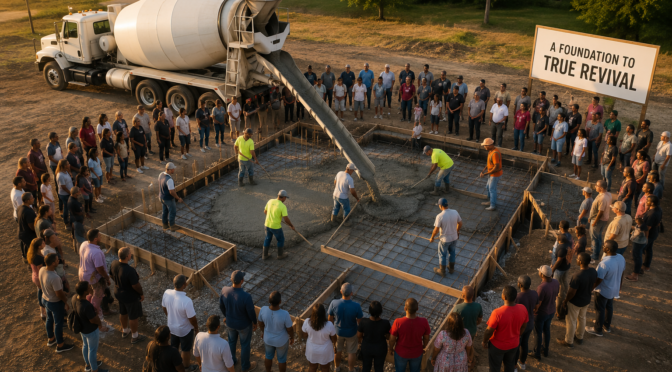
Have you ever watched a building being constructed? Long before the walls go up, workers spend weeks digging deep into the dirt. They pour heavy concrete into the ground. No one sees this part when the building is finished; it is completely hidden. But if that hidden foundation is cracked, the whole building will eventually come crashing down.
I believe that in the modern church world, we have a foundation problem. Today, many churches are struggling. Attendance is shrinking. People are walking away, especially young people. Experts call this the decline of the church, and we often wonder why this is happening. We blame the culture, or technology, or a busy world. But the real problem might be much closer to home. It might be a problem with how we lead.
There is a quiet crisis happening behind closed doors. It happens when church goals and the institutions they serve become so big that personal integrity and honest relationships get tossed aside. It happens when leaders care more about the success of an organization than the spiritual health or character of the people inside it. When the external sheen of a ministry becomes more valuable than the internal health of its flock, the foundation begins to splinter under the weight of the pressure.
The Trap of the “Greater Goal”
Imagine a leader sitting in front of a group of people, staff member or a volunteer. The leader has a massive plan. Maybe it is a new building, a giant program, or a major goal that will make the church look successful. But there is a hurdle in the way. To make this big plan work, someone has worry more about the inage rather than the true calling of the church. It has to break the commitment made to God and the community.
The leader smiles and says, “I know we made a promise. But look at the big picture. Our new goal is much greater than that small promise. I’m sure impact we will make for the kingdom is worth it.”
It sounds very inspiring. It sounds deeply spiritual. But it is a dangerous trap. When a leaders asks us to drop our integrity, to dismiss the real call of the church, for the sake of a “greater vision,” to ensure that the institution looks good, they are making a profound mistake.
I believe they are declaring that the end result justifies the bad choices made along the way. They are treating people like disposable tools to get a job done, to keep the institution alive instead of recognizing that the individuals, small groups and the community are precious partners in ministry. True kingdom work is never built on the wreckage of broken trust. If we have to break our word to build something, we are no longer building God’s kingdom. We are just building our own modern towers of Babel. We are creating institutional idols to lift up and worship.
Learning from an Old Story
This is not a new problem. The Bible warns us about this exact dynamic in a story found in 1 Kings 13.
In this chapter, a young follower of God is given a clear task. God tells him to deliver a message and then go straight home. He is explicitly told not to stop to eat bread or drink water with anyone in that town. His commitment to God is tied directly to keeping this simple promise.
But then, an older, well-known leader arrives. He is an established, respected prophet in the area. This older leader wants the young man to come to his house. The young man initially says no because of his promise to God.
Then, the older leader uses a trick. He claims he has a new, “greater” message. He says an angel told him it was okay to change the rules. The Bible looks right into the heart of the situation and says something chilling: (But he lied to him).
The young man believes the trusted leader. He breaks his original promise and goes to the house to eat. Because he listened to a charismatic leader instead of guarding his own integrity, the story ends in tragedy.
I believe the lesson we learn is that we are to listen to the guidance of God rather than the trappings of humanity. It is easy to succumb to the call of comfort, come, eat and rest may be appealing but God called the young prophet and is calling us into different living.
I do wonder if this is the reason the next generation is walking away?
For a couple of decade we have talked about authentic living. Yet in the life of the church, this top-down, corporate leadership style, the institution must survive does more than just hurt individual people. It is actively driving the next generation away from the church entirely.
I have actively embraced this ideology for more than a decade, claiming “I will be a name of x denomination pastor, so long as the x denomination does not leave me.” But, what I have witnessed is the institution has left. Leaving my family hurt by accusations and deceipt, my wife and even me. I still love God with all my heart soul and the very breath that keeps me alive, but…
I believe most of us will agree that young people today have an incredibly strong radar for fake things. They can spot a lack of honesty from a mile away. They are tired of slick marketing, big corporate church structures, and leaders who act like wealthy CEOs instead of humble shepherds. They see countless stories of church hurt in one version or another and they do not want to be a part of that. In reality. I reality, when young people look at the church, they do not want to see a well-oiled business machine. They want to see something real. They want to see the authentic love of Jesus.
If they see a church leadership culture that values numbers over honesty, they will walk out the door. If they see staff members being treated as disposable objects to reach an organizational goal, they will lose respect for the message itself. When the community they live in is betrayed by the institution, they will stay away. They are not looking for perfection, but they are looking for transparency. They are searching for a community of faith where truth matters, where a person’s word is gold, and where people are loved for who they are, not for what they can achieve or produce for a program.
The current decline of the church is a grace-filled wake-up call. It is telling us that the high-pressure, metric-driven way of doing ministry is breaking down. We cannot fix a broken foundation by just painting the walls, upgrading the light show, or making the production bigger. We have to change the way we live and lead from the inside out.
Is the Way Forward a Quiet Revolution?
So, how do we fix this? How do we find our way back to true health and experience a genuine revival? I don’t believe that the answer is found in creating a more sophisticated strategy or a flashier weekly program. True revival always starts with a quiet movement of the Holy Ghost and a revolution of the heart. It starts when we intentionally move away from heavy, top-down structures and return to the simple, beautiful way of Jesus.
Think about how Jesus started his ministry. He did not build a giant organization. He did not ask his followers to compromise their values to achieve a quick public victory. Instead, he walked along the dusty roads with a small, intimate group of people. He loved them. He washed their feet. He taught them to be completely honest, to love their neighbors, and to keep their hearts pure.
Jesus showed us that the kingdom of God grows organically from the inside out, like a tiny mustard seed planted in the dirt. It does not grow by forcing people to serve a massive institutional machine. To begin a true revival today, I believe that we must find the courage to do church differently.
The Challenge for Today
We need a philosophical transformation of the heart brought about entirely by the Spirit. I believe this starts when we stop viewing the church as a weekly destination to attend or an institution to maintain. It requires shifting our core definition from a noun (a place) to a verb (a way of being together in the world).
To step into this future, we need to embrace several foundational paradigm shifts that will fundamentally change our underlying philosophy:
• From Consumerism to Co-creation: We must stop treating people as an audience consuming a produced spiritual product, and instead view every person as an active, vital, Spirit-gifted participant in the community.
• From Destination to Incarnation: The focus must shift from gathering people into a sacred building to scattering a sacred people out into the everyday spaces where they already live, love, and work.
• From Programs to Relationships: We need to prioritize organic, deep-seated communal life and mutual care over structured organizational metrics, performance, and specialized programming.
• From Success to Faithfulness: We must replace the cultural drive for constant numerical growth with a hunger for spiritual depth, honoring our commitments even when it costs us institutional momentum.
Essentially, doing church differently begins when we completely deconstruct the idea that church is something we go to, and triumphantly reclaim the reality that it is who we are.
But I wonder: are we going to be a people who listen to the mature prophet moving us toward what the world wants, or are we going to hear God’s timeless call to come together, seek to live as Jesus lived, and to, “love each other, just as I have loved you” (John 13:34)?
There is freedom waiting for us if we choose the path of integrity.
Reflection and Community
So let me ask you these questions, and I encourage you to respond in the comments below or in the comment section of the social media post. Let’s start an honest, life-giving conversation together:
1. What institutional tradition do you continue to grasp onto?
2. What would doing “church” differently look like for you in your daily life?
3. Would you consider a church that didn’t necessarily look like what you are used to?
Prayer: Almighty God, give us the courage to embrace your model of church. Strip away our desire for empty success and replace it with a hunger for true integrity. Bring us together, heal our foundations, and revive us by your Spirit. In the mighty name of Jesus, Amen.