
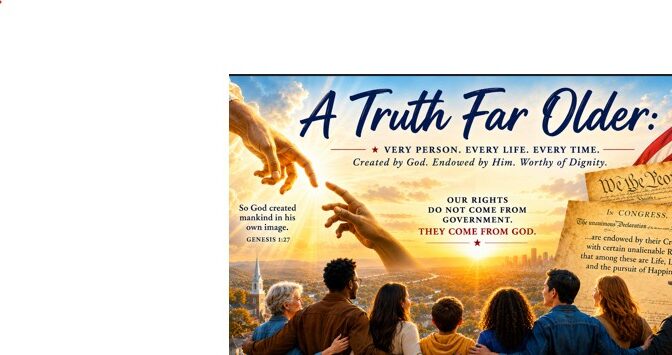
There is a truth that sits underneath everything we believe about human dignity, even if we do not always notice it or know where it came from. Long before there were governments or nations, before laws were written or systems were built, there was a statement made about what it means to be human. It is found in the book of Genesis: “Then God said, ‘Let us make mankind in our image, in our likeness…’ So God created mankind in his own image.” Genesis 1:26–27. That one idea has shaped more of human history than most people realize. It means that every person—every race, every background, every nationality, every personality, every story—carries worth not because of what they do, but because of who they are. Value is not assigned by governments or earned through success. It is given by God simply because He created us.
That belief becomes the quiet foundation for everything that comes later in history, even when people don’t fully live it out. Centuries later, thinkers like John Locke helped put language to this idea by saying that human beings have natural rights—life, liberty, and dignity—that do not come from kings or governments. Governments do not create those rights. They recognize them and are supposed to protect them. That idea eventually made its way into the founding of the United States, where a group of men in 1776 tried to explain why a people might separate themselves from a powerful empire. In the United States Declaration of Independence, they wrote that all people “are endowed by their Creator with certain unalienable Rights,” including “Life, Liberty and the pursuit of Happiness.”
That sentence is worth slowing down for. It does not say the government gives you rights. It does not say society votes on your worth. It says your rights are already there because they come from your Creator. That is a massive shift in thinking for the world at that time, and honestly, it still is today. It places human dignity outside of politics. It places it above governments, above systems, above public opinion, and above power itself. It says that if you are human, you already matter before anything else is said about you.
And yet, the same people who wrote those words were not fully living them. That tension is part of our story, and it is important to be honest about it. At the time of the founding, slavery still existed in the American colonies. That reality sits in painful contrast with the words “all men are created equal.” It is one of the deepest contradictions in American history. Even more than that, in the early draft of the Declaration, there was a paragraph that directly condemned slavery and the slave trade. It called it cruel. It described it as a violation of human nature itself. It was not soft language. It was strong, clear, and direct. It named the injustice without hesitation.
But that paragraph did not make it into the final version. As the colonies debated and tried to stay united, that section was removed. Some delegates objected. Some came from regions where slavery was deeply connected to the economy. Some were not ready to face what it would require if they fully applied that truth to every situation. And so, in order to preserve unity at a fragile moment in history, the paragraph was left out.
One of the main writers of the Declaration, Thomas Jefferson, also lived inside this same tension. He wrote powerful words about freedom and equality that still shape the world today. And yet, in his personal life, he owned enslaved people. That contradiction is hard to hold, and it should be. It reminds us that people can sometimes see a truth before they are willing or able to fully live it. We can write what is right before we have the courage to fully become what we have written.
That is not just a historical observation. It is a human one. We do this more often than we want to admit. We understand love before we consistently practice it. We believe in fairness before we fully apply it. We recognize injustice before we always know how to correct it. And sometimes we speak better than we live. Jefferson and others like him were not exceptions to humanity in that way—they were examples of it.
But here is something important that often gets missed. Even though the anti-slavery paragraph was removed from the Declaration, the idea behind it did not disappear. Truth has a way of surviving even when it is delayed. The belief that every person has value because they are created in God’s image kept working its way through history. It did not stay locked in 1776. It kept pressing forward, shaping conversations, challenging systems, and slowly changing the moral imagination of a nation.
America’s story, when you step back and look at it honestly, is not the story of a perfect beginning. It is the story of an ongoing struggle to live up to what was said at the beginning. It is a nation learning, sometimes painfully, what it actually means to believe that every person carries God-given worth. That learning process has not been smooth. It has included deep division, civil war, injustice, and long seasons where the gap between belief and behavior was wide. The American Civil War is one of the clearest examples of that fracture coming to a breaking point.
And yet, even through that breaking, something else was happening. The nation was being forced—slowly, unevenly, and sometimes unwillingly—back toward its own stated truth. If every person truly has dignity because they are made in the image of God, then that truth cannot stay contained in words alone. It has to eventually shape laws, relationships, and society itself. Over time, it has pushed America forward, not in a straight line, but in a real one. Sometimes forward, sometimes backward, but always circling back to the same question: do we really believe what we said we believed?
That question is still alive today. It shows up in how we see each other. It shows up in how we talk about people who are different from us. It shows up in whether we see others as individuals with stories or as categories to be sorted. It shows up in whether we believe dignity is something that must be earned or something that must be recognized.
This is where the words of Jesus speak so clearly into the middle of our world. When asked what matters most, He said to love God with all your heart, soul, mind, and strength, and to love your neighbor as yourself. And when people tried to limit that idea by asking, “Who exactly is my neighbor?” He responded with a story that broke down every boundary people tried to draw. His teaching consistently pointed in one direction: every human being matters more than the systems that divide them.
That is why this idea from Genesis matters so much. It is not just ancient theology. It is a claim about reality. If every person is made in the image of God, then every person carries value that cannot be taken away by government, culture, or circumstance. That truth existed before America. It existed before any modern nation. And it will exist long after every nation has changed or passed away.
So when we look at America today, the most honest thing we can say is this: we are still becoming what we said we believed. Not because the original idea was wrong, but because it is bigger than any one generation can fully live out. America has not always gotten it right. But it has often returned to the right question. And that matters.
There is something hopeful in that. It means failure is not the end of the story. It means contradiction does not cancel truth. It means progress is possible, not because people are perfect, but because truth is persistent. And if history tells us anything, it is that the idea of human dignity rooted in the image of God does not fade—it keeps calling us forward.
That is why, even with all of our complexity as a nation, there is still reason for gratitude. Not blind pride. Not denial of history. But gratitude that we live in a place where these questions can still be asked openly. Where disagreement can still happen in public. Where change can still be pursued. And where the idea that every person matters can still be spoken without fear.
At its best, America has never been about claiming perfection. It has been about trying to live closer to a truth that was already bigger than us. And that truth is simple, but not easy: every person you meet today is made in the image of God. Every person carries worth. Every person carries dignity. Every person matters.
Not because a nation said so, but because God did.